
Technical Questions
1)
Can Formalin interfere with a stone analysis and/or alter a
stone’s composition?
2)
Does Herring Lab locate the nidus in every stone?
4)
Does Herring Lab ever analyze specimens that are not stones?
5)
Does Herring Lab offer photographs of the stone specimen?
6)
Does Herring Lab use a secure connection for On-line Internet
Resulting that is HIPAA compliant?
7)
Does Herring Lab participate in Proficiency Testing?
8)
Is Herring Lab a Nationally Accredited Lab?
Answers
1)
Can Formalin interfere with a stone analysis and/or alter a
stone’s composition?
Yes.
Although relatively infrequent, formalin solution can convert Struvite to
Newberyite. It may also partially or completely dissolve uric acid and/or
convert it to addition products. These conversions are usually limited to
the surfaces of specimens. Formalin can also reduce the sensitivity of,
or inhibit, certain micro-chemical tests such as a determination of ammonia
using Nessler’s solution.
Specimens
exposed to formalin should be thoroughly air
dried before submission. Please note “formalin” on the lab
requisition.
2)
Does Herring Lab locate the nidus in every stone?
No. Identifying the location of the
“nidus” (plural: “nidi”) is achieved by a thorough optical examination of the
specimen. Non-optical means to
accomplish this currently do not exist. The validity of an identification of the
“nuclear area(s)” of a stone is directly related to the long-term experience
and analytic ability of the analyst.
Several
factors may prohibit, or make unreliable, a determination of the nuclear
area(s) of stone specimens.
Intact
stone structures can be quite irregular in deposition and composition
unrevealing of centric, eccentric or multi-centric nuclear deposits.
Specimens
submitted as partial stones or stone fragments are frequently unreliable for
nuclear determinations for many reasons, such as misleading multi-radial
structures presenting central foci or possibly, outer lamina. Therefore, we normally do not address the
presence or the absence of the nidus for specimens submitted as fragments.
Long-term
experience is most beneficial for reliable identifications of the nidus. Our analysts have between 20 to 33 years of
continuous experience.
3)
Does Herring Lab provide a custom written description of
the stone structure and quantitate the chemical analytes as a percentage of the
whole specimen?
Yes. Our descriptive written report reveals
the structural order of deposition as presented and each chemical analyte is
quantitated as a percentage of the whole.
Standardized non-written formats lack specificity
regarding the applicable structure, order and quantitation of the
specimen. Certain formats use a pre-analytical group of structural
components (e.g., “Core/Shell/Layers” or “Nidus/Body/Surface”) for routine
reporting and quantitate each structural component separately for analytes
(i.e., core total = 100 %, surface total = 100%, etc.). Some include an
additional quantitation of the structural components as a percentage of the
whole. Few include a direct quantitation
of the analytes as a percentage of the whole. Several factors (e.g.,
partial stones or fragments, deeply embedded crystalline structures, homogeny,
etc.) place added concerns upon standardized reporting formats.
4)
Does Herring Lab ever analyze specimens that are not
stones?
Yes.
Approximately 4% of all specimens submitted to Herring Lab are not kidney
stones. Non-stone specimens usually consist of physiological (i.e.,
blood, mucoprotein, tissue, etc.) particulate
matter. These specimens demonstrate none of the substances (typically
crystalline) normally associated with endogenous concretions. The
remaining types of particulate matter are probable mis-collections (i.e.,
synthetic fibers, vegetable matter, rocks, pipe scale, etc.) from the various
settings in which they were obtained. A rare few are intentional
deceptions (stone malingerers).
5)
Does Herring Lab offer photographs of the stone specimen?
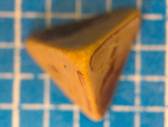
Yes. Detailed photomicrographs are available upon
request for a small additional charge.
Our photos are Kodak Professional Grade, 8½” x 11”, plastic laminated
stock. Two magnified clear images, one
of the exterior and one of the interior, when applicable, are provided on one
sheet of heavy photographic paper.
6)
Does Herring Lab use a secure connection for On-line
Internet Resulting that is HIPAA compliant?
Yes.
Our server transfers our results over a 128 bit encrypted https
connection. As also required by HIPAA, the integrity of the transferred
data cannot be modified by the end-user and logs of all client transfers are
maintained.
7)
Does Herring Lab participate in Proficiency Testing?
Yes.
We have reciprocal arrangements with many of our competitors to provide
semi-annual proficiency testing events. We are happy to provide
proficiency testing services to any laboratory reporting the analytes composing
the specimen. We do not provide this service to laboratories reporting
only cations and anions as this type of analysis does not establish the
analytes present. We are also happy to assist any laboratory with their
difficult specimens for an additional charge.
8)
Is Herring Lab a Nationally Accredited Lab?
Yes.
We are inspected bi-annually by State and Federal agencies and hold the
following licenses:
Florida ………… L800000126
CLIA …………. 10D0275094
California
…….. COS 800232
Maryland
…….. 322
Rhode
Island …. 325
NPI …………… 1881677441
EIN …………… 59-1360679


Copyright © - Louis C. Herring & Company, Inc.